
The mechanics of DeFi vaults and their practical applications for individual investors have been widely discussed. But a larger shift is now underway. The same infrastructure that powers yield strategies for retail participants is attracting institutional capital at a pace few anticipated.
In January 2025, an EY and Coinbase survey found that 83% of institutional investors either hold digital assets or plan to within the year. More telling: 75% of those institutions expect to engage with DeFi protocols within two years. JPMorgan processes over $2 billion daily through its Kinexys blockchain platform. BlackRock's tokenized Treasury fund, BUIDL, now holds more than $2.3 billion across eight blockchain networks. Tokenized U.S. Treasuries alone surpassed $9 billion in 2025, a 256% increase from the prior year.
Traditional financial infrastructure was built for a different era. It still works, but the friction it creates has become harder to justify.
Three structural problems compound across every transaction:
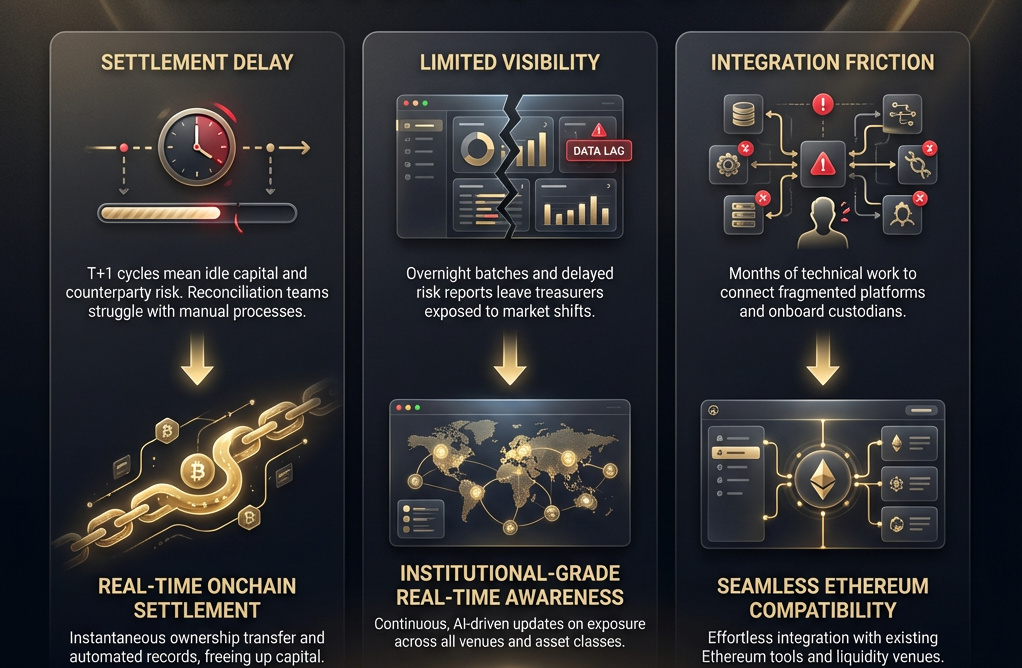
These are not minor inconveniences. Large asset managers maintain dedicated operations teams whose primary job is ensuring that internal records match external confirmations. Errors are common, a single mismatched trade can trigger days of investigation across multiple systems that were never designed to communicate with each other.
The costs are structural; they compound across every transaction, every reconciliation cycle, and every delayed decision.
When institutions hear "DeFi vault," many picture speculative yield farming or high risk liquidity pools. That perception misses what vaults actually represent at a technical level.
A vault is a programmable container for capital allocation. It accepts deposits, executes predefined strategies, and issues tokens that represent proportional ownership of the underlying assets. The logic governing deposits, withdrawals, and strategy execution lives in auditable code rather than manual processes.
The distinction matters:
This shift gained momentum with ERC-4626, a token standard finalized in 2022 that defines a universal interface for tokenized vaults. Before this standard, every protocol implemented vaults differently. Integrating with multiple yield sources required custom adapters for each one, creating development overhead and potential security gaps.
ERC-4626 changed the equation. Any vault following the standard exposes the same functions for deposits, withdrawals, and share accounting. Aggregators, dashboards, and lending markets can integrate once and support hundreds of vaults automatically.
The adoption curve reflects institutional interest:
For traditional asset managers, the implication is clear: vaults built on open standards offer a path to programmable, auditable, and interoperable asset management without rebuilding systems from scratch.
The efficiency gains from vault based systems are measurable and operating at scale.
Settlement provides the clearest example. Where traditional markets requires at least a day, blockchain based systems settle in minutes or seconds. When a vault accepts a deposit, the transaction finalizes on the blockchain immediately. There is no multi-day window of counterparty risk. No reconciliation required between multiple record keepers. The blockchain itself serves as the single source of truth.
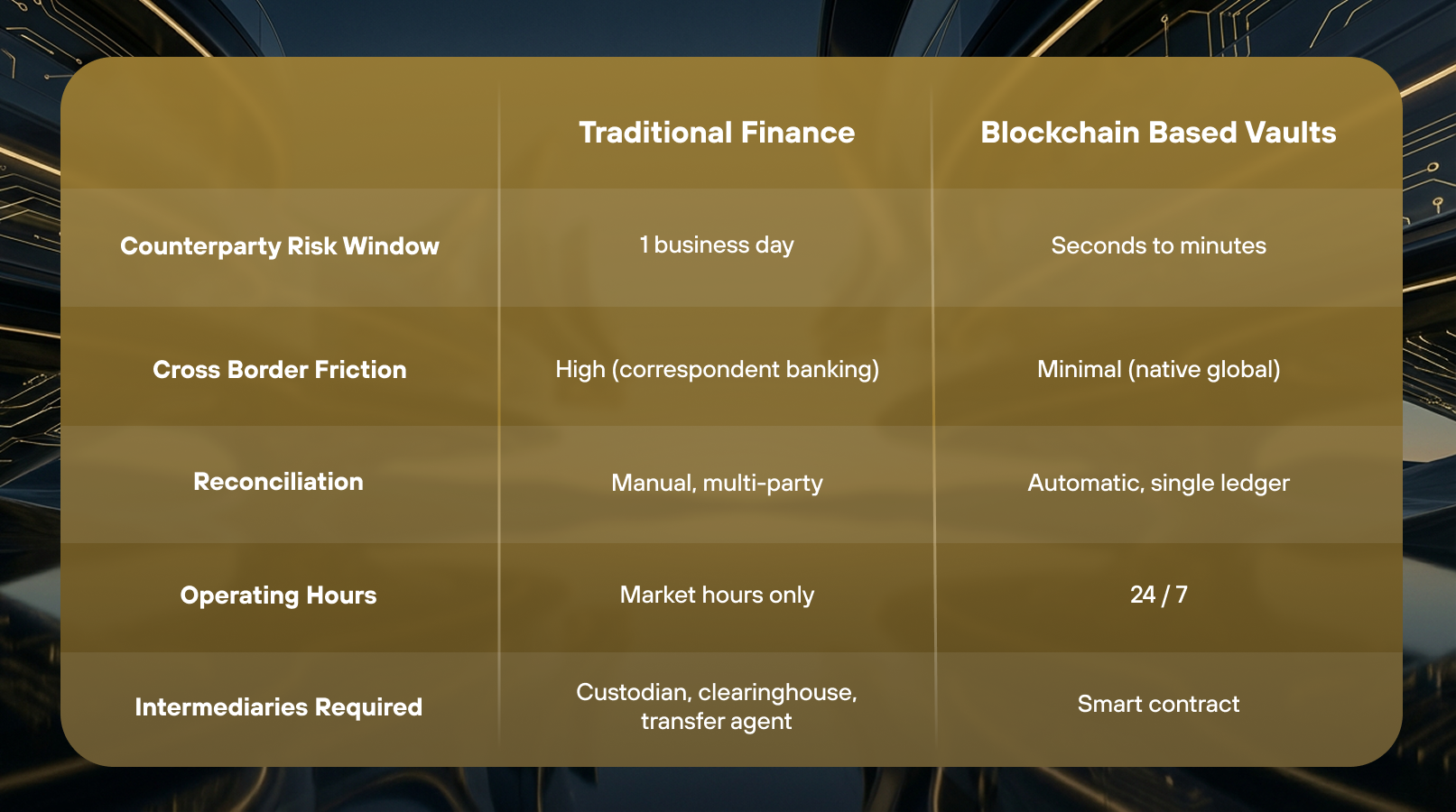
JPMorgan's Kinexys platform demonstrates these efficiencies at institutional scale. The platform has processed over $1.5 trillion in notional value since launch, with daily volumes exceeding $2 billion. In April 2025, JPMorgan expanded Kinexys to support British pounds, adding LSEG and Trafigura as early clients for 24/7 cross border settlement between New York, London, and Singapore.
The October 2025 launch of Kinexys Fund Flow extended this infrastructure to private markets. The system tokenizes investor records and uses smart contracts to move capital automatically between brokerage accounts and fund managers. What previously required manual wire transfers and multi day reconciliation now executes programmatically.
Beyond settlement, vaults automate functions that traditionally require dedicated teams. Rebalancing happens according to predefined rules rather than manual intervention. Yield harvesting and reinvestment compound automatically. Fee calculations and distributions execute at the smart contract level with full transparency.
For a treasury managing positions across multiple venues, this means fewer operational staff dedicated to routine execution and more capacity for strategic decisions. The infrastructure handles the mechanics, people focus on judgment.
Settlement speed is only part of the equation. The same infrastructure that enables instant execution also transforms how institutions monitor and report on their positions.
In traditional finance, portfolio visibility depends on batch processing. Custodians send reports at end of day, prime brokers reconcile overnight, risk teams compile weekly summaries. By the time those summaries reach decision makers, they may no longer reflect current exposure. This lag is not a technical limitation anyone chose, it is a consequence of systems built before real time data sharing was feasible.
Blockchain based vaults invert this model. Every deposit, withdrawal, and strategy adjustment records directly to a public ledger. Portfolio composition is not reported periodically. It is observable continuously, by anyone with the address.
For institutions, this creates three distinct advantages:
This transparency is inherent to how blockchains function. For institutions accustomed to opacity as a competitive shield, this requires adjustment. But for those who recognize that trust is increasingly built through verification, onchain transparency becomes a differentiator rather than a vulnerability.
Transparency becomes even more valuable when capital needs to move across multiple venues and protocols, and this is where vault infrastructure reveals its full potential.
Traditional multi venue management is painful. Each exchange, each custodian, each prime broker requires separate integration. Capital fragments across accounts. Margin sits in silos. Moving liquidity from one venue to another involves wire transfers, approval chains, and settlement delays that multiply the friction described earlier.
Vault based systems approach this differently. A single vault can aggregate exposure across multiple underlying protocols. One deposit provides access to diversified yield sources, liquidity pools, or lending markets. The vault handles routing, rebalancing, and optimization internally. The institution interacts with one interface while gaining exposure to many.
This architecture enables three forms of efficiency:
This interoperability matters because institutions will not replace their entire technology stack overnight. Vault infrastructure succeeds precisely because it can layer on top of existing processes, capturing efficiency gains without forcing wholesale transformation.
Multi venue access introduces complexity. Managing risk across diverse protocols requires frameworks that match institutional standards. The question many traditional firms ask is whether onchain systems can meet those requirements.
Recent events in DeFi have reinforced a fundamental principle: vault management is risk management.
As vaults evolved from simple yield wrappers into structured products combining leveraged lending, rehypothecated collateral, and multi venue exposure, they became what risk professionals now call "risk containers." The sophistication increased, but the risk infrastructure often did not keep pace.
When complex yield structures fail, the pattern is consistent:
What appears as isolated product failure is often a symptom of deeper architectural gaps: solvency risk from collateral that depegs without triggering liquidation, liquidity risk from venues with gated redemptions, and yield volatility that exceeds depositor expectations.
For institutions evaluating vault infrastructure, the question is not whether vaults can generate yield. The question is whether the risk framework governing those vaults can satisfy the same standards applied to traditional managed products.
September 2025 provided a significant data point. Société Générale, through its digital assets division SG FORGE, became the first major global bank to deploy capital into permissionless DeFi. The vehicle: Morpho protocol vaults on Ethereum mainnet.
This was not a pilot program or sandbox experiment. A top 20 global bank placed real capital into public blockchain infrastructure alongside other DeFi participants. The decision followed months of due diligence and required developing an institutional risk framework from the ground up.
The methodology SG FORGE developed offers a blueprint for institutions evaluating similar deployments:
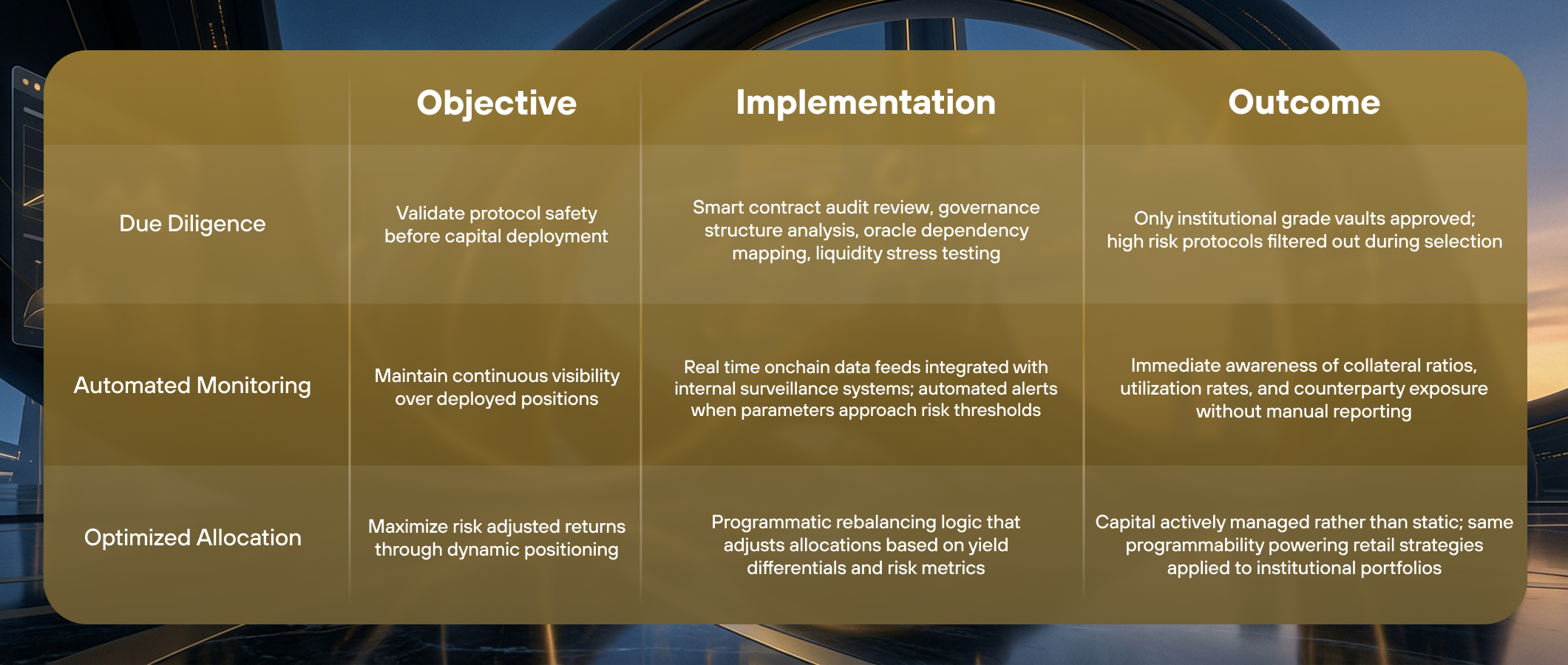
What makes the SG FORGE case significant is not the size of the deployment. It is the validation that a systemically important financial institution concluded the risk reward profile was acceptable. If Société Générale's compliance, legal, and risk teams approved permissionless DeFi exposure, the infrastructure has crossed a threshold that smaller institutions can reference. The frameworks are operational, tested, and now documented as a precedent for others to follow.
The path from evaluation to deployment does not require a complete infrastructure overhaul. Institutions entering vault based systems typically start with contained, low risk applications before expanding.
Practical entry points include:
These pilots allow teams to build operational familiarity, test monitoring systems, and develop internal expertise before committing larger allocations.
The regulatory environment now supports this progression. What was uncertain territory two years ago has evolved into defined frameworks across major jurisdictions:
Integration does not mean replacement. The most successful institutional deployments follow a hybrid model: existing systems remain operational while vault infrastructure layers alongside, capturing efficiency gains in specific use cases. As comfort and expertise grow, the allocation expands naturally.
The infrastructure is mature, the regulatory clarity exists. The question facing institutions is no longer whether blockchain will reshape asset management, but whether they will be positioned to benefit when it does.
The institutions already deploying capital through vault infrastructure are not experimenting. JPMorgan is processing billions daily through Kinexys. BlackRock is scaling tokenized treasuries across eight networks. Société Générale is entering permissionless DeFi with institutional risk frameworks. These are strategic positions put in place by leading institutions.
What these organizations recognized is that vault based systems are not a parallel financial universe, they are an upgrade layer for the infrastructure that already exists. Faster settlement, continuous transparency, programmable compliance, and capital efficiency that traditional systems cannot match.
The transition will not happen overnight. Legacy infrastructure took decades to build and will take years to evolve. But the direction is clear. Every month brings new regulatory frameworks, new institutional deployments, and new evidence that the gap between traditional and onchain finance is narrowing.
For family offices evaluating treasury alternatives, for fund managers seeking operational efficiency, for corporate treasurers exploring yield on idle capital: the entry points are defined, the frameworks are tested, and the institutions setting precedent have already moved.
The infrastructure is ready. The path forward is visible. What remains is the decision to begin.


